
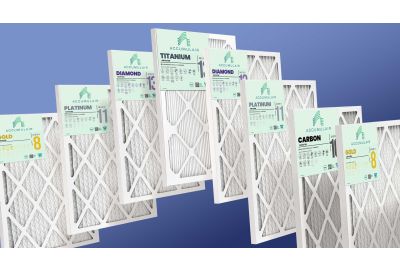
You've probably heard both versions. One says buy the highest MERV rating on the shelf because more filtration is always better. The other says never go high, because a strong filter chokes your system and runs up your energy bill. Both are trying to answer a real question with a single rule, and that's where they go wrong.
The honest answer is: it depends on your system. And the good news is your system already tells you what it can handle. You just have to know where to look.
Where the "higher strains your system" idea comes from
It isn't made up. A higher MERV air filter captures more, and it captures more faster. On the thin 1-inch filters most homes use, that fuller filter can restrict airflow sooner than a lower-rated one would. Push it too far past what your system was built for and you can add resistance the blower has to fight, which is where the higher-bill and faster-wear warnings come from.
So it is a real concern. It's just been flattened into "lower is always safer," which is its own mistake. Getting something at the opposite end on the MERV spectrum, like a cheap fiberglass filter that barely catches anything isn't protecting your equipment or doing much for the air moving through your home.
The number on the filter isn't the only thing that matters
Filter thickness is also something to take into account. A system built to take the larger 4- to 5-inch filters can safely run a higher MERV rating, and hold it for longer, because that thicker filter has far more surface area for air to pass through. The same rating that feels restrictive in a 1-inch slot can breathe easily in a 4-inch one.
That's why two homeowners can follow opposite advice and both be right for their own houses. The filter that suits a newer system with a deep filter cabinet is not the filter that suits an older unit with a 1-inch slot.
Your manufacturer already set the max rating
Before you settle on a rating, check your HVAC unit's manufacturer manual. It will list the maximum recommended MERV rating for your system. That number is the real limit, and staying at or under it is how you avoid the straining your systems air blower.
If you don't have the paper manual, the manufacturer and model number on the unit are usually enough to find it online. This is the best way to know how high you can go with your air filters.
For a lot of households, a MERV 11 filter, replaced on schedule, lands in a good balance: it provides solid filtration without putting too much strain on the system. It's a reasonable default to start from, assuming it falls within your manufacturer's maximum.
Sometimes it takes some trial and error to find the MERV rating and replacement schedule that fit your house.
The habit that matters more than the rating
Whatever rating you land on, the thing that actually protects your system is keeping an eye on the filter. A filter that's done its job and loaded up with debris restricts airflow regardless of it's MERV rating. The problem people blame on high MERV is often just a filter left in too long.
How often you'll need to swap it depends on more than the rating. A home with pets, nearby construction, heavy pollen seasons, or a lot of foot traffic loads a filter faster than a quiet, low-dust household. Check yours regularly, learn your own home's rhythm, and replace on that rhythm rather than a generic calendar reminder.


