

For the first time, Boise, Idaho is the hardest place in the United States to live with pollen allergies. That's the top line of the Asthma and Allergy Foundation of America's 2026 Allergy Capitals report, and it's a genuine shift. Boise wasn't near the top before. Now it leads the list.
Right behind it: San Diego, Tulsa, Provo, and Rochester fill out the top five. AAFA ranks the 100 largest U.S. metros using tree, grass, and weed pollen scores, over-the-counter allergy medicine use, and how many board-certified allergists are available locally. More than 106 million Americans now live with allergies, asthma, or both.
The bigger story in this year's data is the West. More western cities landed in the top 20 than in past years, and AAFA points to spikes in grass and weed pollen as the reason. Pollen seasons are also running longer and hitting harder, and parts of the country now see pollen year-round.
If you're in one of these cities, you already know. Here's the part worth your attention: you can't lower the pollen count outside, but you have real say over the air inside your house.

Did your city make the 2026 list?
Here are the top 20 Allergy Capitals for 2026, grouped by region.
The West took over
Eight of the top 20 are in the West, and the top of the list belongs to it.
- Boise, ID (#1)
- San Diego, CA (#2)
- Provo, UT (#4)
- Ogden, UT (#8)
- Spokane, WA (#9)
- San Francisco, CA (#11)
- Salt Lake City, UT (#13)
- Colorado Springs, CO (#15)
South and Central
- Tulsa, OK (#3)
- Wichita, KS (#6)
- Little Rock, AR (#16)
- New Orleans, LA (#18)
The Southeast
- Raleigh, NC (#7)
- Greenville, SC (#10)
- Richmond, VA (#14)
- Winston-Salem, NC (#19)
- Lakeland, FL (#20)
Midwest and Northeast
- Rochester, NY (#5)
- Minneapolis, MN (#12)
- Toledo, OH (#17)
You can see the full ranking of all 100 cities in the AAFA report.

Why the air inside your house matters more than you think
Most people picture allergy season as an outdoor problem. The air inside your home can be more polluted than the air outside it. The EPA lists indoor air pollution among the top five environmental health risks, and pollen, pet dander, and mold spores all end up circulating indoors, where you spend most of your day.
That's the piece you control. You can't change Boise's, or wherever you live, pollen count but You can change what your HVAC system does with the pollen that gets inside your house.
The American College of Allergy, Asthma & Immunology is direct about it: for people with allergies, air filtration reduces airborne allergens and may provide some relief. A 2011 review of the clinical literature found the same, with the clearest benefit when filtration is paired with other steps like keeping humidity down and vacuuming with a HEPA machine (source).
What the allergists actually recommend
If you have central heating and air, the ACAAI's guidance is specific: use a disposable filter with a MERV rating of 11 to 13. Their rule of thumb is that the higher the rating, the better. A filter in that range catches pollen, pet allergens, and mold without choking your airflow.
They also name what doesn't work. According to the ACAAI, cheap fiberglass furnace filters have been shown to be ineffective, and even a good filter left in place too long stops doing its job. The fix is boring but real: replace it on schedule, usually every three months.
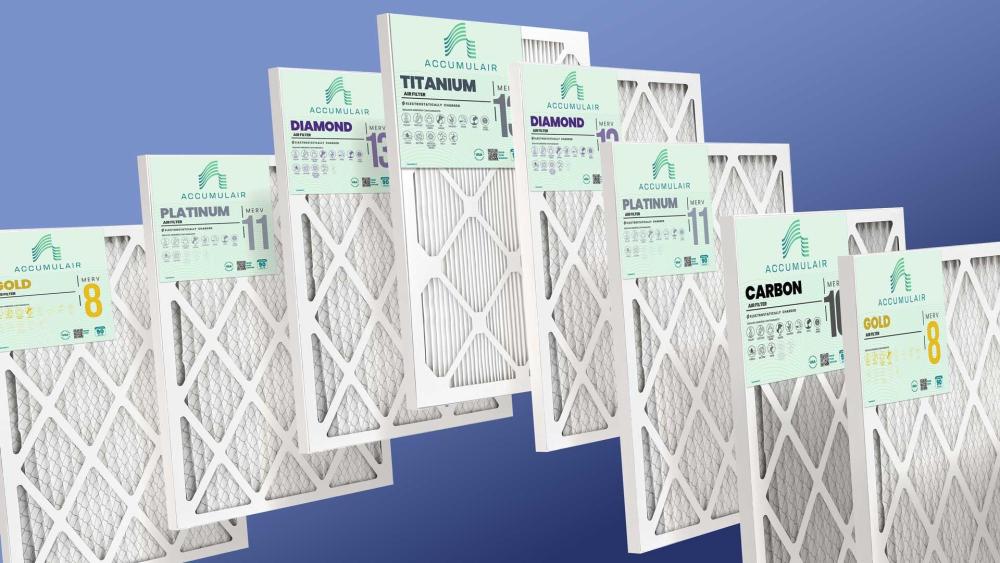
Airfiltesr.com offers two filters in the range the ACAAI names:
- Accumulair Platinum MERV 11 captures up to 85% of airborne particles, including pollen, pet dander, ragweed, mold spores, and smoke.
- Accumulair Diamond MERV 13 captures up to 91%, adding VOCs and particles that carry viruses.
If your system uses an odd or hard-to-find size, that's the specific problem we exist to solve. Standard sizes like 16x25x1 and 20x20x1 are easy to buy anywhere, and the big-box stores stock them because they move fast. The trouble starts when your system takes something they don't carry. Older homes, custom HVAC work, and high-end systems often call for sizes you won't find on a shelf, and when the exact size isn't available, people improvise. They round to the nearest size and hope the gap doesn't matter, or they cut a larger filter down to fit.
Both of those quietly cost you. A filter that's even slightly too small leaves gaps at the edges, and air takes the path of least resistance, so a chunk of it slides past the filter instead of through it. All that pollen, dust, and dander you were trying to catch rides straight back into your rooms. The filter looks like it's working. It isn't, or at least not the way a filter that seals to the frame does.
That's the whole reason we carry the sizes we do. We make custom and hard-to-find dimensions to the exact measurements your system needs, in the same MERV 11 and MERV 13 media the allergists recommend, so the filter fills the housing the way it's supposed to and the air actually goes through it. A filter that fits is the one that does the work.
The part of allergy season you actually control
You didn't pick your city's pollen count, and you can't vote it down. If you're in Boise, San Diego, Tulsa, or any of the other cities near the top of AAFA's 2026 list, the outdoor air is going to do what it does this season.
Inside your house is a different story. The filter in your HVAC system runs every time the air kicks on, pulling pollen, dust, and dander out of the air you breathe all day. A MERV 11 or MERV 13 filter, sized to actually fit your system, is a small thing you can change this week that keeps working long after the pollen forecast scrolls off your phone.
Start by pulling the filter you have now and reading the size printed on the frame. If it's a standard size, you have plenty of options. If it's one of the odd ones, that's what we're here for. Find your size and get a filter that fits the system you actually own.
All MERV data and statements are indicative of typical properties and characteristics obtainable; MERV claims are to be used as a guide for general comparison and not as a specification.


